 Meredith Kenton
7 min read
Clorox Screen+ Sanitizing Wipes: The Solution for Germ-Free Devices
Screens are everywhere, from classrooms and offices to checkout counters and healthcare stations. They keep us connected, but they’re also one of the...


 JANSAN
BradyPLUS delivers strategic services and product consistency to keep your facilities cleaner and more sustainable, people safer, and operations more productive, every day.
 FOODSERVICE
Our best-in-class brands deliver the quality you demand at prices you’ll appreciate. We know how to address every need with products designed and manufactured for unmatched performance, consistency, and value.
 PACKAGING
Our range of services and key partnerships with top equipment providers and suppliers ensure productivity, safety, sustainability, and uptime. We deliver consistent quality, ensure product availability, and add value when markets fluctuate.
 ABOUT US
At BradyPLUS, we prioritize serving you by participating in local events. Visit our events page to see when we'll be in your region, offering customized solutions to meet your facility operations needs.
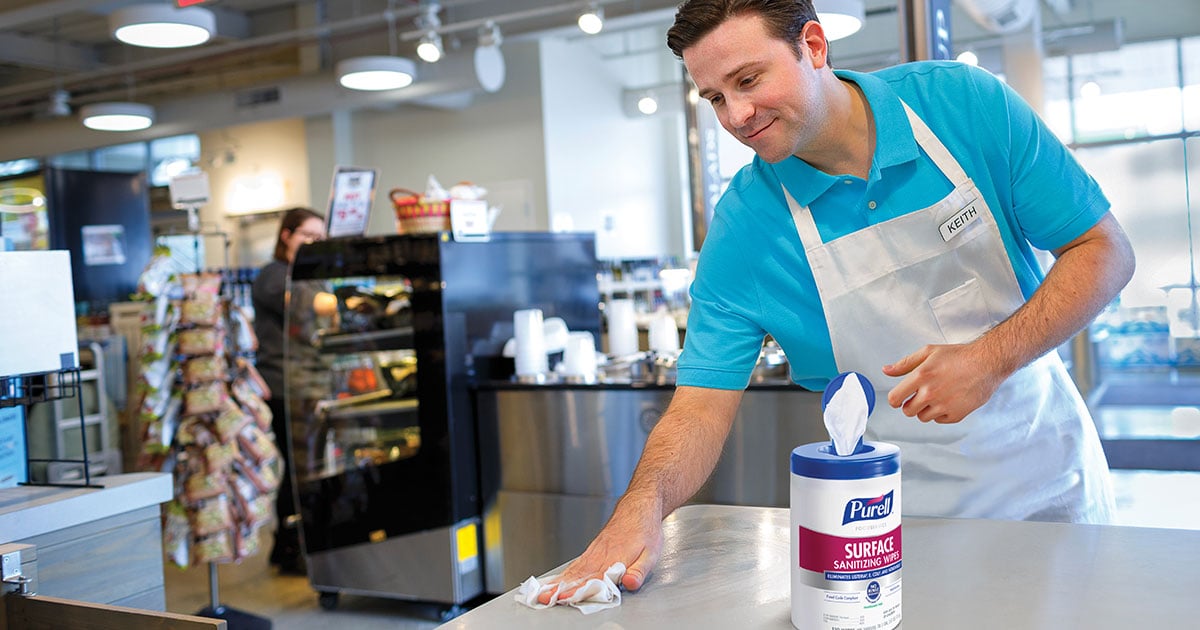
Imagine you’re seated at a table that’s just been wiped down. You watch the waiter walk away with the bucket and rag in hand. Off to a great start – clean table, happy customer. But is it really safe to eat?
While a clean surface might look good, it could still be full of harmful bacteria and pathogens. The crumbs are gone, but if the process stops at cleaning, your customers could still be at risk.
Understanding how to properly use a food safe sanitizer is crucial for keeping restaurants safe and customer satisfaction high.
Let’s break down what cleaning really means, where many restaurants go wrong, and what the correct way to do cleaning and sanitizing actually looks like.
Cleaning, sanitizing, and disinfecting are often incorrectly interchanged, but they each have their own distinct meaning.

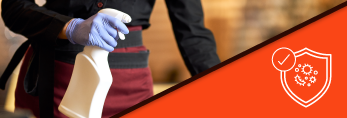
If you’re operating a commercial kitchen, simply cleaning tables or prep areas isn’t enough. A properly applied food-contact surface sanitizer is required to reduce pathogen risk and maintain compliance.
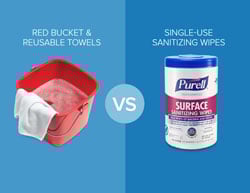
For decades, many restaurants have relied on the traditional red bucket system: reusable towels stored in a diluted restaurant sanitizer solution and used throughout the shift.
While common, this method introduces several food safety and operational risks.

Restaurant sanitizer solutions must be mixed at exact concentrations (PPM).
Too weak? Ineffective.
Too strong? Potentially unsafe and non-compliant.
Maintaining correct concentration requires constant monitoring with test strips and frequent bucket changes, something that can easily slip during busy service.

Reusable wiping cloths are often used across multiple tables and prep surfaces.
According to the PURELL® Brand1, research shows that reusable cloths can harbor bacteria and contribute to cross-contamination if not properly managed. In some testing scenarios, wiping down a surface with a contaminated cloths actually increased bacterial counts on surfaces.
If the towel is compromised, every surface it touches may be compromised.

To do it right, the red bucket system requires:
In today’s labor environment, added complexity increases the likelihood of shortcuts and risk. Still, if you're using the red bucket method and all this isn't being regularly and properly performed, there's a real chance your team is doing more harm than good as they wipe down tables.
Beyond compliance concerns from being more complicated than it seems, the bucket-and-rag method carries hidden operational costs. Even if it seems to be cheaper at a surface level. Labor time, test strips, laundering, solution replacement, and table-turn delays all add up.
If you want to see how reusable towel systems compare to ready-to-use food-contact surface sanitizing wipes in your operation:
👉 Use the Cost Comparison Calculator from the PURELL® Brand to evaluate your daily costs.
Many operators are surprised at how competitive ready-to-use systems can be, especially when labor efficiency is factored in.

This is a question we hear at BradyPLUS a lot.
Here is our recommendation for cleaning and sanitizing food-contact surfaces in a commercial kitchen:
To reduce dilution errors and cross-contamination risks, many operators are transitioning to ready-to-use surface disinfection systems.
Food-contact surface sanitizing wipes eliminate:
 Mixing errors PPM monitoring Shared buckets Towel laundering Reusable cloth contamination
They standardize compliance and simplify restaurant sanitizing procedures.
Solutions like PURELL® Foodservice Surface Sanitizer wipes are formulated for food-contact surfaces, require no rinse, helping reduce cross-contamination risks and maintain operational efficiency.
Beyond safety, visible sanitizing also impacts guest perception.
When guests see modern, ready-to-use surface disinfection systems in place, it reinforces confidence in your cleanliness standards.
Food safety is everyone’s business.
A solid food safety plan will help ensure your restaurant is:
A food-contact surface sanitizer is only effective when paired with the correct process, and a system designed to reduce human error.
If you're reviewing your current surface disinfection strategy, now is the time to ask:
Take the first step towards a healthier restaurant now and download the Wipes Cost Comparison Calculator from the PURELL® Brand. Ditching the red bucket is easier (and more affordable) than you think!
Sources:
1. PURELL® Brand Surface Solutions eBook: Going Beyond Surface Deep on a Key Well-Being Topic

7 min read
Screens are everywhere, from classrooms and offices to checkout counters and healthcare stations. They keep us connected, but they’re also one of the...
12 min read
When it comes to food processing—cleanliness is always top of mind. For food processors, there are federal and state regulations to ensure that the...

7 min read
As the weather gets warmer and the days get longer, the transition into summer brings the promise of outdoor dining and seasonal delights and...